
Memory Lane
It seems somewhat fitting that now, March 11, 2026, almost two years ago to the day that ChatGPT 4 was released (I distinctly rememeber asking GPT3.5 to create a song about something in the style of Nine Inch Nails, but my ChatGPT.com history only goes back to March 27, 2023.
Compare March 2023 with March 2026. (I have no idea why I was interested in this.)
), I’m writing my first thoughts on it.
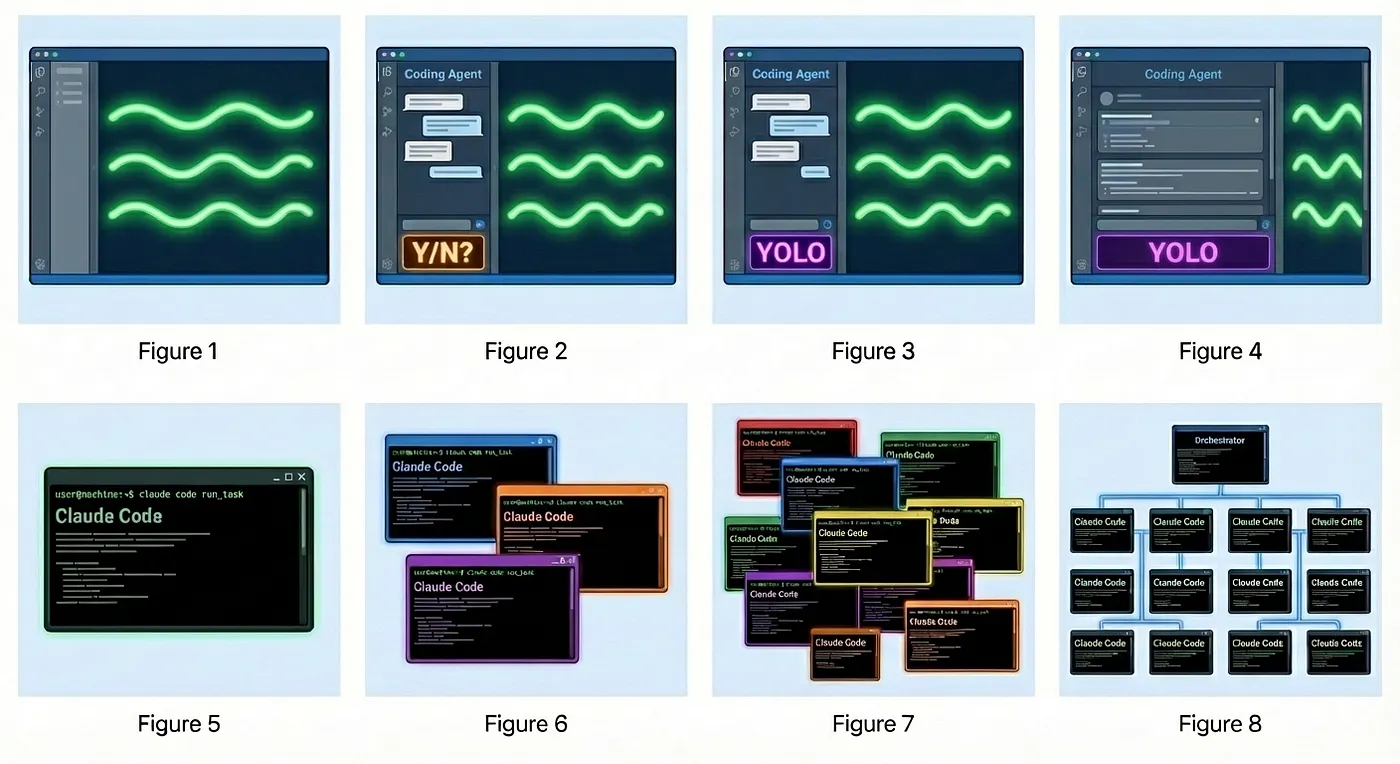
I’ve been writing code using LLMs since the chatGPT introduction. Wildly, I mostly followed Steve Yegge’s stages and am on about “Stage 6” in his chart.
A Confession
I must, however, confess I never was in love with the art and craft of programming. I would listen to people who talked about the Law of Demeter and spent hours building just the right keyboard and had a VIM config that was as long as my arm and could navigate with blinding speed and efficiency and go “Wow, I am never, ever going to be as good as they are.”
I lost interest in software development because I was forced to care about things my brain just couldn’t. “Your method is too long! It must be less than 8 lines of code!” the linter would yell. And I would dutifully apologize and break it up into many small methods, for reasons that I still don’t understand and still find much more confusing and difficult to read and reason about than one larger method. Yes, I understand what you are asking. No, I cannot make my brain hold onto it while I’m coding.
I also hated the programming languages: PHP (mixing logic and presentation? Blech!), Java, JavaScript, C++, all felt obnoxious and didn’t jive with how my brain worked. I found Ruby/Rails in 2005 and actually started enjoyed programming again - but always knew I wouldn’t be the mythical “10x” developer. I was probably a 2x developer, because I cared about things not sucking and did help move things forward, but the job market tends to be bimodal so either you’re a enterprise programmer, toiling away in the salt mines or working at the latest startup making millions at acquisition.
I am techincal, so I know what a good database is and what isn’tBut it’s web scale! , how to talk about architecture, I can tell the difference between acceptable code and hot garbage, rife with security holes and ineffiency. But I’m not the worlds best programmer and never will be. I maximally enjoy the results of programming and only minimally enjoy the act of programming itself.
So I went into management and later entrepreneurship. I transitioned from manager to director to CTO, then CEO and With some exits!
 .
.
I love the art of creation. Of starting from nothing and building a thing that people liked and wanted to pay for. For this, I absolutely love Agentic programming. Gone are the days in which I am sitting at my computer, stuck trying to figure out the best way to get started. I never have to worry about getting too far into something and realizing I need to refactor but am too demoralized to do so. Agents can refactor in an instant. Law of Demeter? That a problem for the agent to figure out. It’s internalized all this stuff so I don’t have to.
Yes, there are plenty of things to worry about, still, but the minutae? It’s got it handled. In the “copy-paste from ChatGPT web window” era I still wrote some “by hand”; now, in the Agentic era?
 the code I’ve written since ChatGPT is written by the LLM. I’m not too worried about increasing complexity of software or bugs or whatever - in the long run, more/better/etc. AI will render the inability for a human developer to “keep up with” the output moot.
But even with all this, I see growing storm clouds on the horizon. Since any given product feature’s cost is essentially Development Hours x Hourly Rate, agents shrinking development time to minutes or seconds drive that cost toward zero - fundamentally skewing the cost/benefit ratio. Hell, the ROI calculation approaches infinity! This means anything we can think of we ought to build, right?!

A Not-so-brief Digression on Complexity
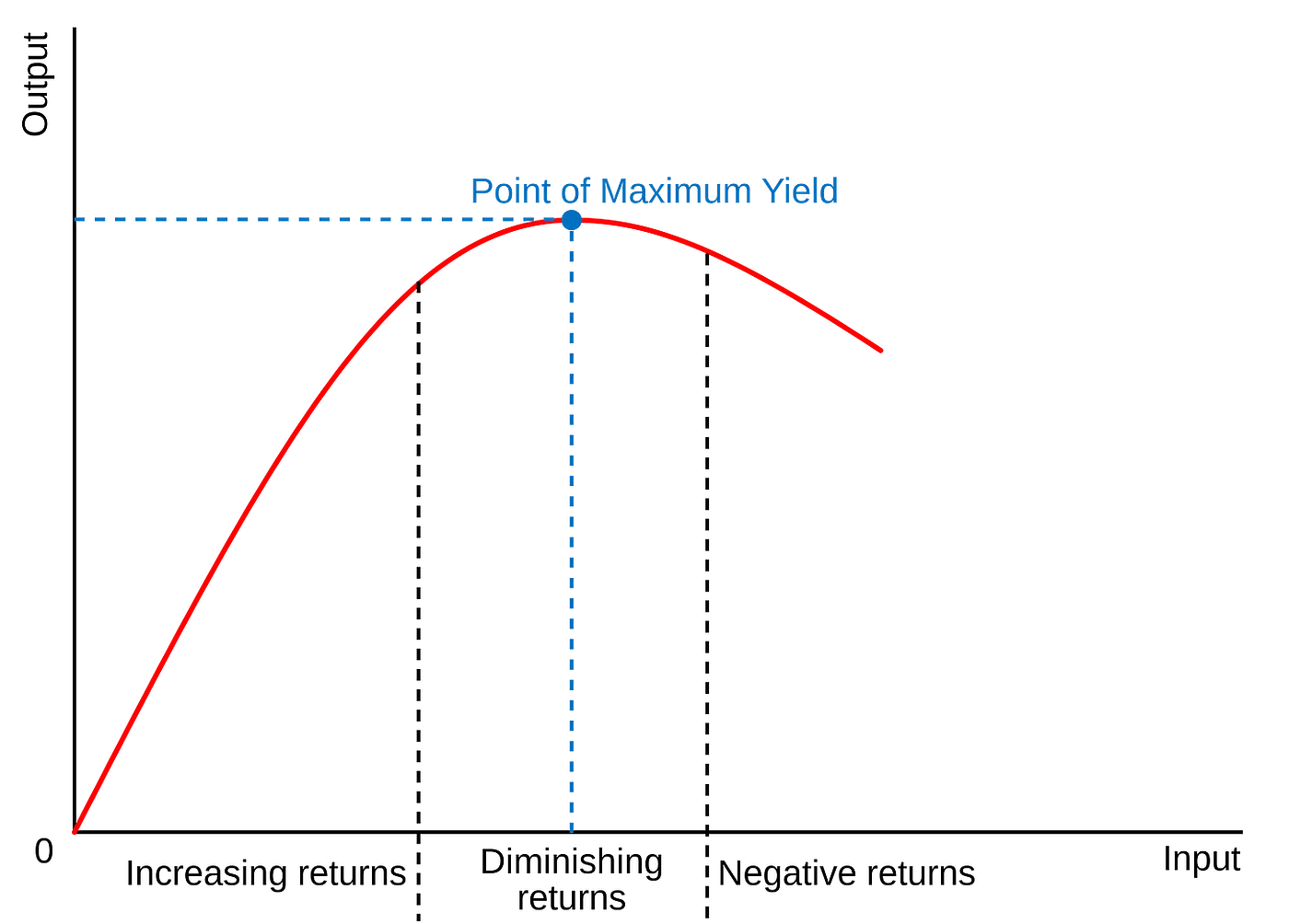
In the olden days (you know, like a year ago, or right now for anyone who isn’t currently using AI to build software) product development hit diminishing returns.
Why? Well, Fernando suggests:
- Support and maintenance workload
- Building difficulty
- Customers’ expectations and demands
You can read his excellent post to get more information but I think you can easily fill in the blanks as to what those are. But where the “Customers’ expectations and demands” are more in terms of “we need more from the product and it’s not giving it, I’m gonna leave” I think we’re missing a big one that is essentially contra to “we need more”:
- Product has hit the “Coherence Threshold”
What’s the Coherence Threshold?
Before we dive into the exact definition let’s talk about software complexity. Complexity - as identified by Brooks in “No Silver Bullet” - can generally be broken up into two types: essential and accidental.
Development Complexity
Essential complexity - inherent to the problem itself. You cannot remove it without changing what you’re solving. A tax filing product is complex because taxes are complex. That’s irreducible.
Accidental complexity - introduced by your tools, architecture, process, history. It’s complexity that serves the implementation, not the problem. It can theoretically be eliminated.
Brooks’ point was that most of the hard work in software is essential, and that’s why there’s no silver bullet: you can clean up accidental complexity with better tools, but you can’t automate away the essential kind.
But that’s really focused on a software development perspective. I think there’s something about that in a product, too.
Product Complexity
We all know that Microsoft Office is complex. The essential complexity is huge because as a general-purpose productivity suite, the surface area of the problem to be solved is gigantic! Microsoft Word can be used to make a letter and the envelope the letter is mailed in! As well as make clip art and send faxes and zillion other things. That’s essential to solving someone’s problem.
The accidental complexity is that you might only use it to type up angry letters to the editor but someone else might use it to send faxes and someone else might use it to make HTML webpages and clipart! But you get everything in one package even if you don’t use it.
One person’s essential complexity is someone else’s accidental (and vice-versa).
Coherence Threshold
The coherence threshold of a feature is the point when the marginal cognitive load imposed on the user by a new feature exceeds the marginal value that feature delivers to them. The essential complexity is overwhelemed by the accidental.
The product’s coherence threshold is the point at which a product’s complexity begins to cost users more than it returns to them - when the burden of understanding what the product can do starts to erode the value of what it does do.
So what does this have to do with agents?
Another Digression on Product Development Loops
Product development functions as an What’s an OODA loop? Check out my other post: How Winners Win: John Boyd . We gather data, generate hypotheses/tests, perform an experment, get the results, and go back to step 1.
This takes real, actual time. It takes looking at the data, how people are using the product. You need to talk with them. You need to wrestle with incomplete, inaccurate, or incoherent feedback, using judgement to make decisions without full information. Sometimes users say they want a thing but they don’t. Some users use your product in ways you never intended, some use only small parts while others might strain the bounds of your design.
Either way, there are rarely hard-and-fast rules, almost never only easy decisions to make. Should we build X or Y? Well, that’s a matter of some combination of value (“Return on Investment”), strategy (do we want to do X?), alignment (prioritzation, integration with other parts of the company), etc.
When you can go from “Idea” to “Working Feature” as quickly as you can bash out some words in a prompt box, we’re skipping a large part of product development that we used to ask is: should we build this thing at all?
Should we build this thing at all?
Since everything is free to build now, why should we ask this question? What’s the point?
When build costs trend to zero, every feature looks worth adding. But, total product value is asymptotic, not linear.

Coherence Threshold Revisited
Each feature past the inflection point adds value for some and subtracts it from others.